

Why in news?
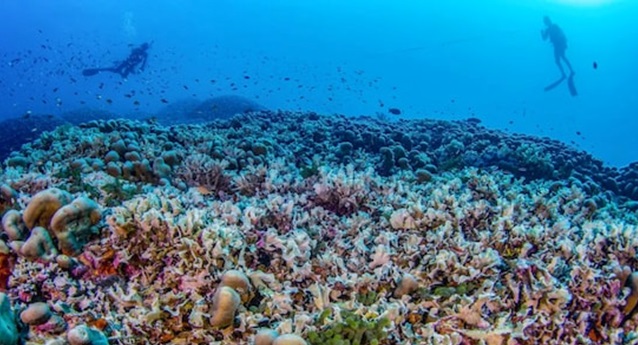
- Scientists have found the largest coral ever in the southwest Pacific Ocean.
- Mega coral, which is a collection of many connected, smaller organisms.
- It was discovered in Solomon Islands.
- This island is located about 2,000 km north-east of Australia.
- It can be more than 300 years old.
- According to the discoverer, seeing the coral was like seeing an "underwater cathedral".
- They say that it is even bigger than a blue whale.
- It is 34 meters wide, 32 meters long and 5.5 meters high.
Coral:
- It is a type of marine organism.
- It is also called Praval.
- They are made up of genetically similar organisms, called polyps.
- There is a mutual relationship between corals and algae.
- Corals provide algae with compounds necessary for photosynthesis.
- In return, algae provide carbohydrates to corals.
- These are lime-based organisms with a hard structure.
- The calcium carbonate released by them forms rocks inside the sea.
- These are called coral reefs or coral rocks.
- Coral reefs are also called rainforests of the sea.
- These are the second richest ecosystem in the world.
Favourable conditions for corals:
- Temperature:
- Most hard corals thrive in water ranging from 23° to 29° Celsius.
- Some corals can also live in temperatures ranging from 20° to 32° Celsius.
- Salinity of water:
- They need salty water to survive.
- The salinity of sea water should be between 27% and 40%.
- Water depth:
- They are adapted to living at depths less than 30 metres (100 feet).
- Light:
- They require a lot of light.
- Water transparency:
-
- Corals do not grow well if the water is opaque.
«
»
- SUN
- MON
- TUE
- WED
- THU
- FRI
- SAT